

Gold and Bitcoin Didn't Fail as Havens. They Got Used as ATMs.
This week gold fell about 9%, $BTC broke its summer low, and the Nasdaq had its biggest one-week drop in more than six years. Gold and Bitcoin are supposed to be where money runs when stocks crack. This week they were where money came from.
That is what a liquidity squeeze looks like. This one didn't start this week. It started in 2025, when the AI buildout stopped paying for itself with cash.
How we got here: from cash flow to credit
For the first few years, the hyperscalers paid for AI capex out of cash flow and equity, the cleanest money there is. Then the bills outgrew the cash.
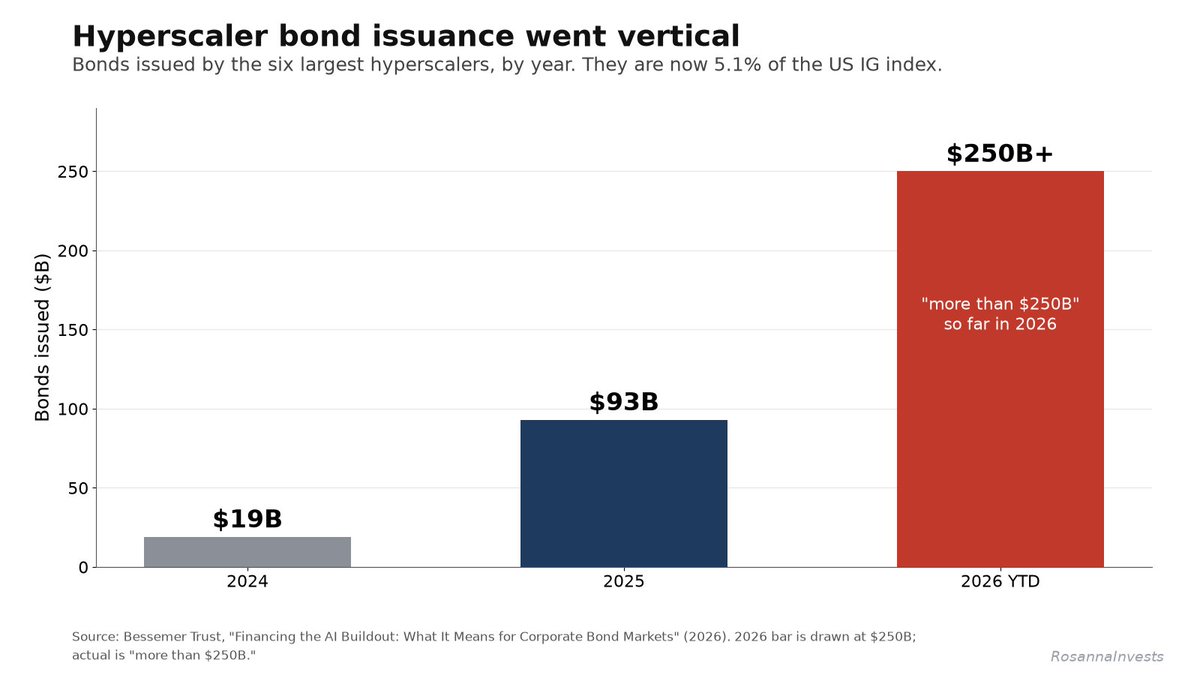
The six largest hyperscalers issued $19B of bonds in 2024, $93B in 2025, and more than $250B so far in 2026. They're now 5.1% of the investment-grade index (Bessemer Trust). Leases grew even faster. Moody's says the big five doubled lease commitments to $969B, with more than two-thirds not yet on balance sheets. $META's Hyperion vehicle with Blue Owl alone raised $27.3B (IFR). $ORCL sold $10B of stock and $10B of notes on Nov 2 (CNBC).
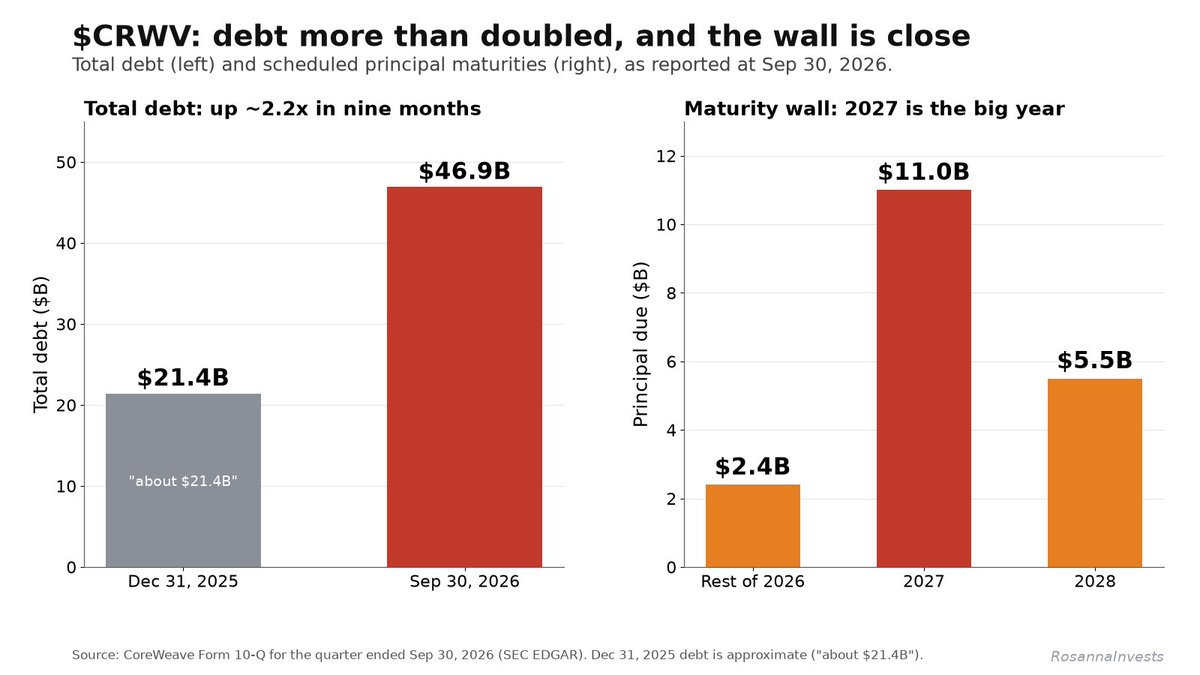
The neoclouds went furthest. $CRWV carried $46.9B of debt at Sep 30, up from about $21.4B at the end of 2025. That includes GPU-backed delayed-draw loans at 7% to 15% effective rates, senior notes at 9% to 10%, and $7.7B of vendor (OEM) financing (10-Q).
In other words, the GPU itself became the collateral. That works when money is cheap and chips rent at high prices. Money is no longer cheap. Whether rents stay high is the other half of the story, and I come back to that below.
Where the stress is
The stress is not everywhere. The hyperscalers are paying more to borrow, but they can still borrow. The stress sits in the levered layer.
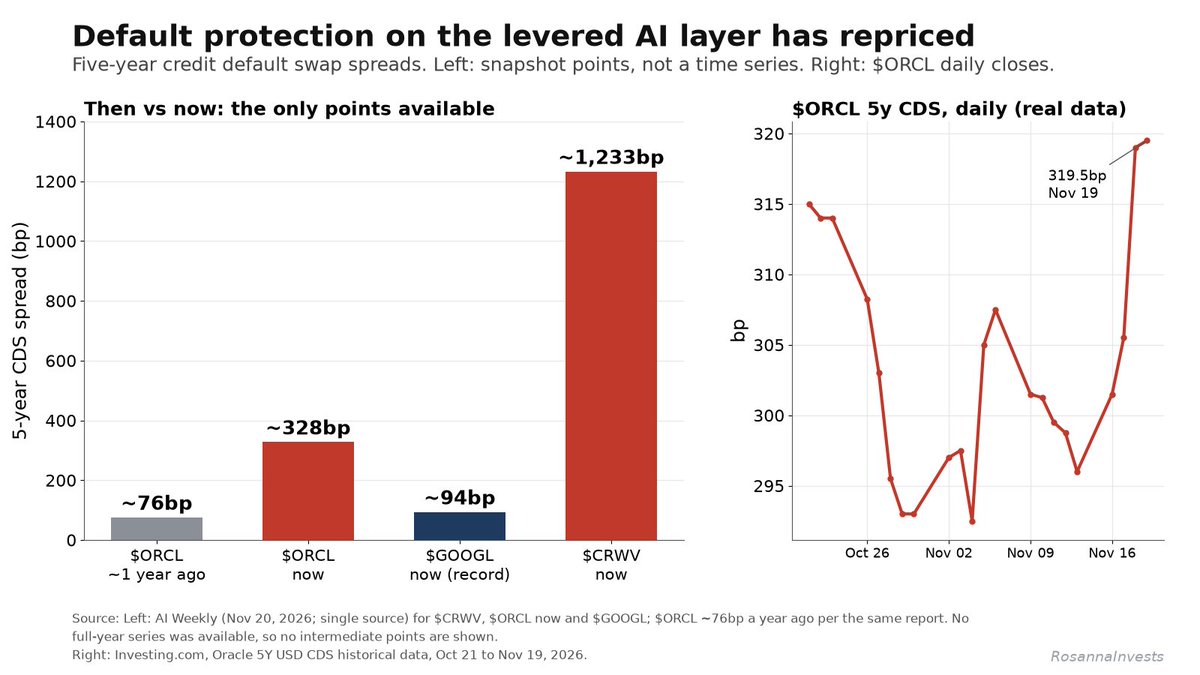
Credit default swaps. Five-year CDS on $CRWV widened to about 1,233bp today. $ORCL is about 328bp, up from about 76bp a year ago, and even $GOOGL hit a record of about 94bp (AI Weekly; $ORCL was 319bp on Nov 18 per Investing.com).
Bonds. $CRWV's 9.75% notes due 2031 have traded near a 16% yield. 78 of 91 hyperscaler bonds issued in 2026 trade wider than at issue (LPL).
Banks. Lenders are balking even at deals backed by Google or Anthropic, and ING put about $500M of data center loans up for auction (Reuters via Investing.com, CNBC). $NBIS shelved a high-yield bond and took a $3.5B secured Citi loan instead (same Reuters report).
Vendor financing. SEC enforcement staff are examining $NVDA's accounting. Reuters ties investor worry to circular financing and $NVDA guarantees on data center projects, and the interim CEO says $NVDA will be "far more selective" (Reuters). $NVDA closed down 12.27% today.
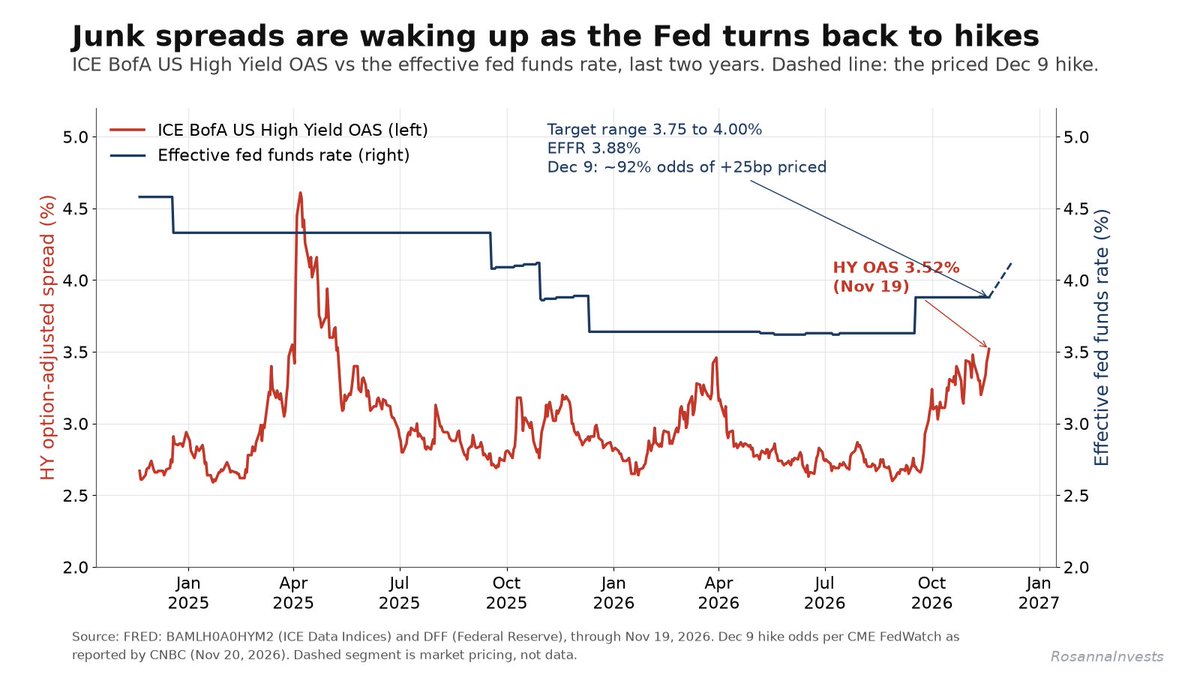
The broad market is only starting to notice. High-yield spreads rose to 3.52% from 3.20% a week earlier, and investment-grade to 0.94% from 0.89%. I haven't found an AI-linked default or covenant breach, and $CRWV was in compliance at Sep 30. My read is that this is a sector credit squeeze, not yet a systemic credit event.
Rates and refinancing
Debt-funded buildouts need two things: lenders willing to roll the debt, and rates that don't punish you for it. Both are under pressure.
Fed funds sit at 3.75% to 4.00%, and futures price better than a 90% chance of another hike on Dec 9. Governor Waller floated 50bp (Reuters via Investing.com). The 10-year traded 5.04% to 5.15% earlier this week before a flight to safety pulled it to 4.91% today. A 10-year TIPS auction cleared at a 2.903% real yield on Thursday, the highest since 2002.
Now line that up against $CRWV's calendar: $2.4B due in the rest of 2026, $11.0B in 2027, $5.5B in 2028 (10-Q). Management says it won't issue parent-level unsecured debt "at current yields" through 2027 (CNBC).
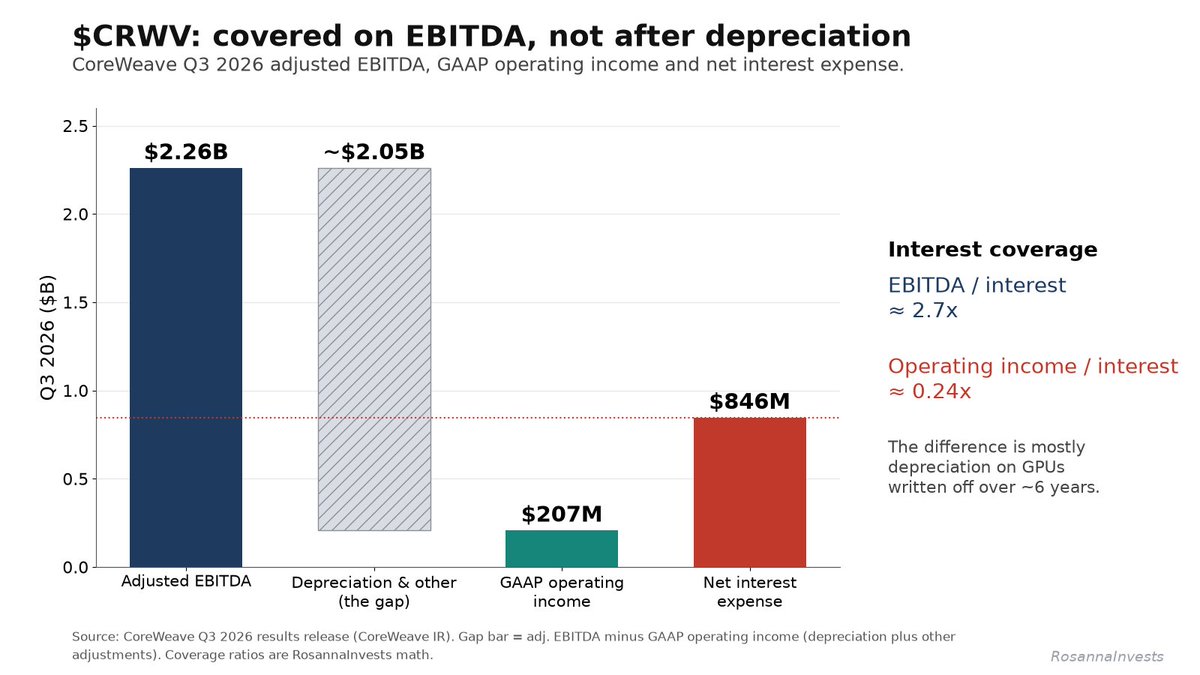
The question that matters is whether revenue covers the debt before the hardware ages out. In Q3, $CRWV's adjusted EBITDA of $2.26B covered $846M of net interest about 2.7x. GAAP operating income of $207M covered it about 0.24x (CoreWeave IR; coverage ratios are my math). The gap is depreciation, on chips most of the industry writes off over about six years (CNBC).
GPU rents, at least, are rising. The H100 averaged $3.52 an hour in November, up 6.7% from October (GPU Rental Prices index). The risk is concentration. Two unnamed customers were 30% and 24% of $CRWV's Q3 revenue (Komposite), and OpenAI, a key counterparty across the sector, raised $15B, half its target (Dealroom).
So the model holds as long as rents stay firm and lenders keep rolling. If either one slips, coverage gets thinner. Neither has broken yet.
Why Bitcoin and gold get sold
When leverage meets falling prices, the margin call doesn't ask what you'd like to sell. You sell what you can.
Pepperstone's Chris Weston put it best: "Gold has become a source of liquidity rather than a destination for safety" (The National).
Gold. Spot was near $3,538 at 5 PM ET after a low of $3,502.93, its lowest since September 2025. It's down about 9.5% this week, its worst week in eight months, and more than a third below January's record of $5,515. High Ridge's David Meger called it "forced liquidations of gold positions to cover losses" (CNBC). The giveaway is that gold fell today even as the 10-year yield dropped about 10bp, which Kitco reads as portfolio liquidation overriding the usual rate relationship. The World Gold Council says the selling is coming mainly from leveraged futures traders, while gold ETF holders kept adding (WGC). Add a dollar at its highest since April 2025 and real yields near 2.9%, and the near-term backdrop for gold is heavy.
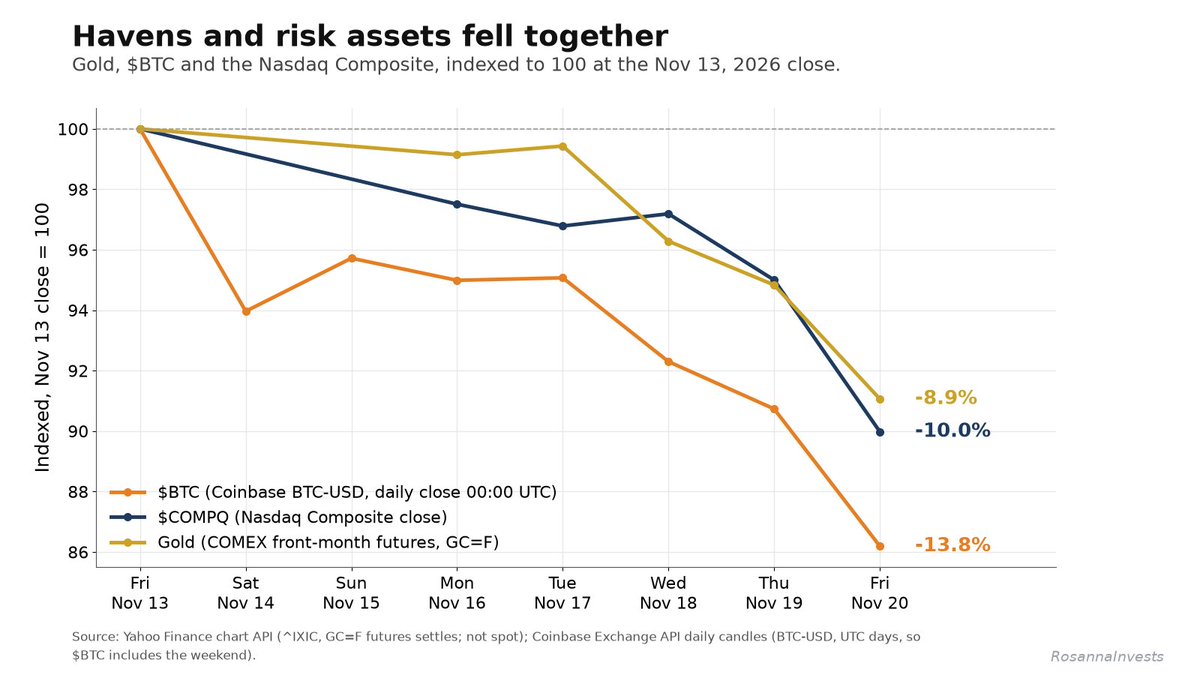
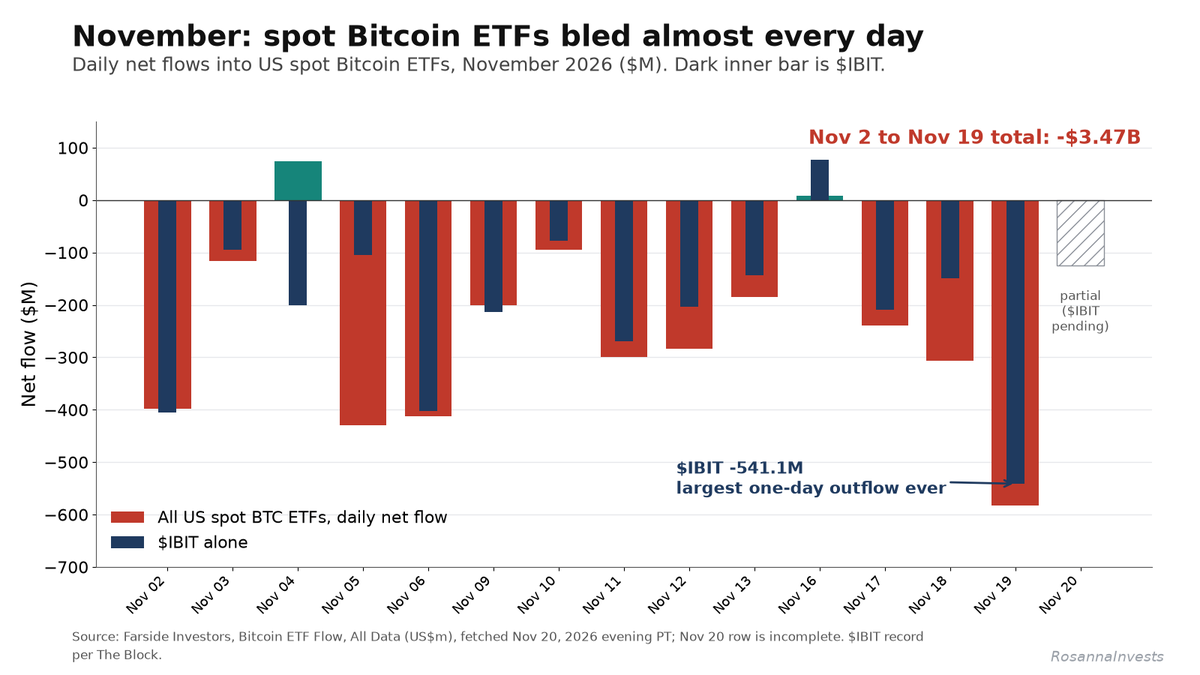
Bitcoin. $BTC hit about $57,655 on Coinbase today, undercutting the July 1 low of $57,717.55. That's roughly 54% below the Oct 6, 2025 peak of $126,296, and under the 200-week average near $68,100. US spot Bitcoin ETFs have bled about $3.47B in November, and $IBIT posted its largest one-day outflow ever, $541.1M, on Thursday (The Block). About $1.53B of crypto positions were liquidated in 24 hours, $1.38B of it longs (Bitcoin.com, citing CoinGlass). The miners that pivoted to AI data centers got hit hardest: $IREN closed down 17.97%, $CIFR 16.13%, $WULF 14.94%.
Scott Freeman of Delphi Digital summed it up: "This isn't just a crypto story or an AI story. It's a liquidity story" (CoinDesk).
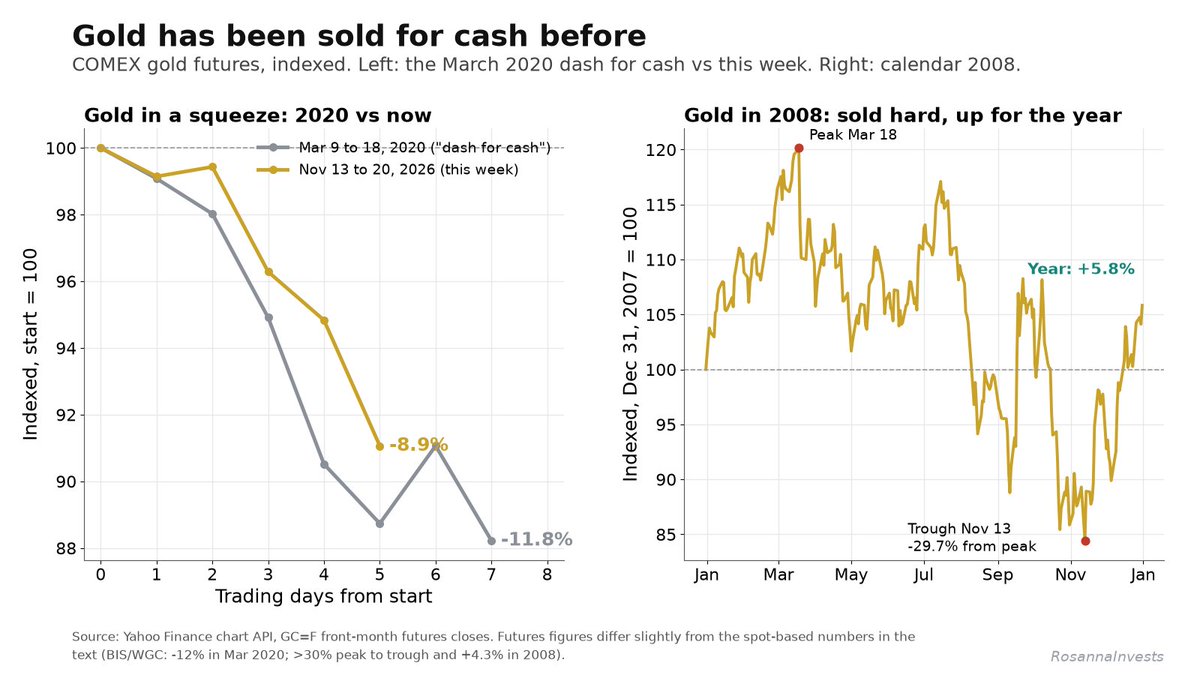
This has happened before. From March 9 to 18, 2020, in the "dash for cash," gold fell 12% while margin calls surged more than 500% (BIS). In 2008, gold fell more than 30% peak to trough, yet it finished the year up 4.3%. In a squeeze, the liquid winners get sold first. That selling, on its own, does not settle the long-run case for either one.
My view on Bitcoin hasn't changed either. It benefits only if people choose to hold earnings in it, use it as collateral, or settle debts with it. Right now debts are settled in dollars, and Bitcoin is the collateral being called away. A squeeze like this is a live test of that thesis, not a verdict on it.
What I'm watching
Squeezes like this end when the forced sellers are done, not when the headlines improve. In March 2020, that flush came before the next leg higher. That is history, not a forecast. Here's what I'm watching, in both directions:
- The Dec 9 Fed meeting. A 25bp hike is priced in. A 50bp hike, or a signal of faster hikes, would add pressure. A hold, or a softer path, would ease it. Freeman's worry is a Fed "hike into" slowing growth.
- Credit spreads. High-yield OAS versus 3.52%, CDS on $CRWV and $ORCL, and where the $CRWV 2031s trade. A narrowing from here would be a sign the squeeze is easing. A further widening would be a sign it's deepening.
- The refinancing window. Whether neoclouds can roll 2027 maturities at workable rates, and whether banks keep selling data center loans or step back in.
- GPU rental prices. Firm rents keep the debt serviceable. A reset on contract renewals would thin coverage. Rents are still rising, so this one, for now, leans toward holding up.
- $NVDA's probe and vendor financing. A pullback in circular financing or guarantees would mean less funding for the chain. A narrower scope, or no finding that changes those practices, would leave this funding channel in place.
- Flows. Wintermute wants $BTC back above $68,000 with a return to spot ETF inflows (Bitcoin.com). For gold, Weston wants real yields to stabilize and the dollar to pull back. Continued $BTC ETF outflows, or a turn lower in gold ETF buying, would point the other way.
The AI buildout still has real demand behind it, and the hyperscalers can still raise money. I haven't found an AI-linked default. The stress sits in the levered layer, and this week's selling in gold and Bitcoin looks like a dash for cash. Whether the squeeze eases or deepens from here is an open question. The signals above are how I'll read it.
Originally published on X by Rosanna Prestia, MBA (@RosannaInvests): https://x.com/RosannaInvests/status/2123990600777396525